
FAQ
Gunite questions, answered.
Straight answers about how gunite and shotcrete work, what we build, and how to get started — from a family-owned crew with 20+ years on the Texas Gulf Coast.
What is gunite, and how is it different from fiberglass or vinyl pools?
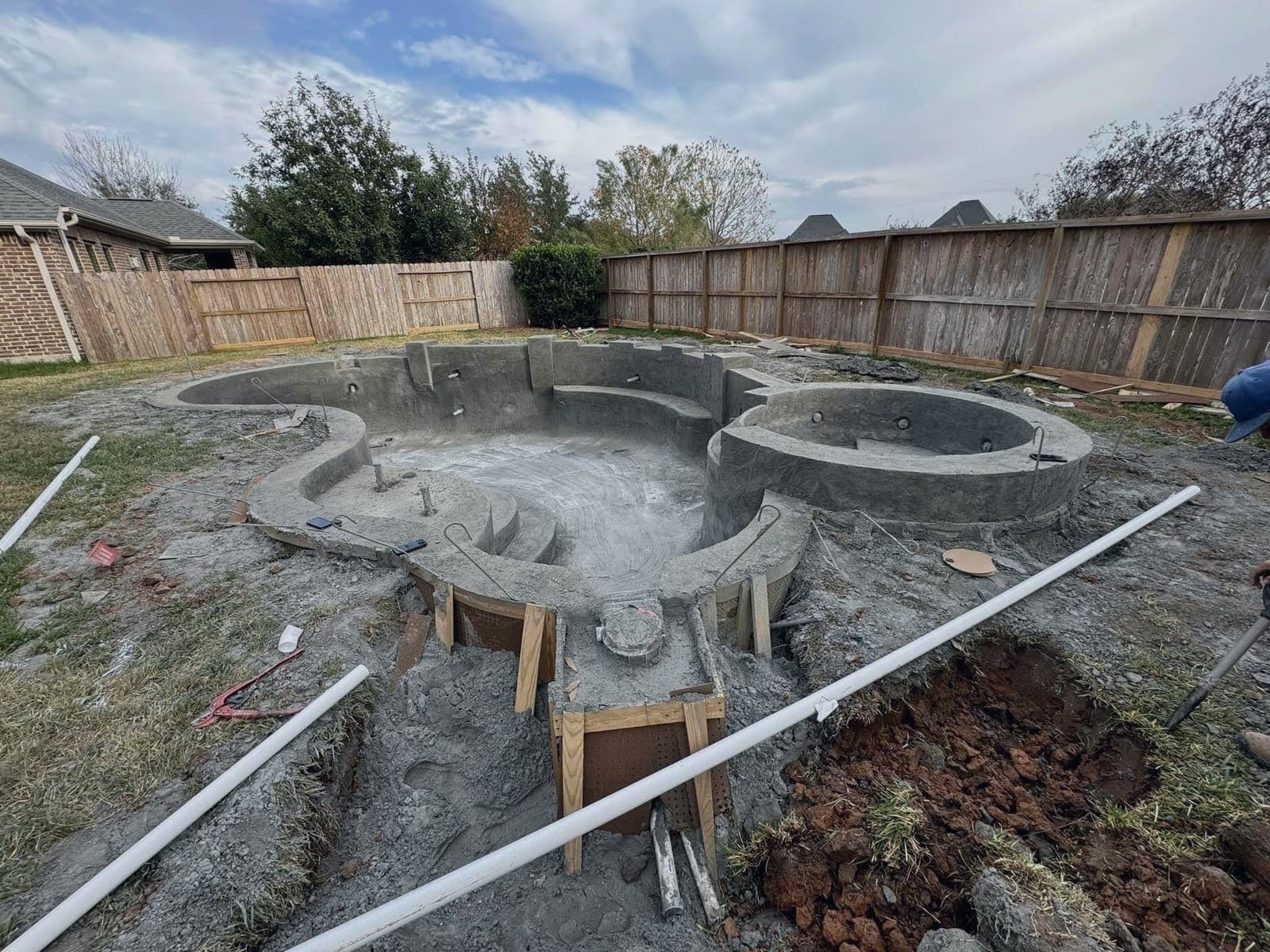
Gunite is a mixture of sand, cement, and water sprayed at high pressure over a steel-reinforced (rebar) frame to form a pool's shell. Because it's built on-site rather than dropped in as a pre-made mold like fiberglass, a gunite pool can be made in virtually any shape, size, or depth — and it's the most durable type of in-ground pool. It's the same proven method used for everything from custom backyard pools to large commercial structures.
What's the difference between gunite and shotcrete?
Both are pneumatically applied (sprayed) concrete — the difference is when the water is mixed in. With gunite, a dry mix is combined with water right at the nozzle as it's sprayed; with shotcrete, the concrete is mixed with water first and then pumped. Both create exceptionally strong structures, and South Coast Gunite works with both for pool and structural projects.
What do you build besides swimming pools?
Quite a bit. Alongside custom gunite pools and spas, we create rock features, waterfalls, grottos, and rock slides; apply commercial and structural shotcrete for aquatic and commercial projects; build engineered retaining walls; and handle pool renovations and repairs. We also work as a gunite and shotcrete subcontractor for pool builders and general contractors who need an experienced crew for the structural shell.
Can you build custom shapes, rock features, and waterfalls?
Yes. Because gunite is sprayed on-site over a rebar frame, it can form almost any shape — freeform pools, tanning ledges, raised spas, and built-in benches. Our crew also hand-crafts artificial rock, boulders, waterfalls, grottos, and rock slides designed to look and feel natural.
How durable is a gunite pool, and can an older pool be renovated instead of replaced?
A properly built gunite shell is the most durable pool construction available and can last for decades. Because the shell is so strong, aging pools can usually be repaired, re-shelled, resurfaced, or remodeled rather than torn out — structural repairs and renovations are a large part of what we do.
Does a gunite pool hold up to Gulf Coast heat, storms, and shifting clay soil?
Yes — a steel-reinforced gunite shell is built for the Texas Gulf Coast. We shape and cure every shell so it reaches full structural strength, and proper steel placement and engineering help it stand up to expansive clay soils, intense heat, and storm conditions. Our work has held through hurricanes, freezes, and floods for more than 20 years.
How long does it take to build a gunite pool?
It depends on the design, site conditions, weather, and permitting, so timelines vary from project to project. Gunite construction happens in stages — excavation, steel and plumbing, shooting the gunite shell, then curing, finishes, and decking. We'll walk you through a realistic schedule for your specific project when we provide your estimate.
How long does gunite take to cure?
Gunite gains most of its early strength in the first week and keeps strengthening for weeks after. Curing is not the same as drying. The shell needs to stay moist so the cement fully hydrates, which is why we water-cure rather than let it dry out. On the hot, sunny Gulf Coast, proper curing is one of the most important steps for a long-lasting shell.
How thick should a gunite pool shell be?
Residential gunite shells are commonly around six inches thick through the walls and floor, with extra thickness and steel where the engineered plan calls for it. The right number comes from the design and engineering for your specific pool. Correct thickness over properly placed steel is what gives the shell its strength.
Can you shoot just the gunite shell as a subcontractor?
Yes. A large part of our work is shooting and finishing the structural shell for pool builders and general contractors who want an experienced crew on the gunite. We handle the shell, and your team or ours handles the rest of the build.
How soon can plaster go on after the gunite is shot?
Plaster does not go on immediately. The shell needs time to cure and gain strength first, and the tile, coping, and other prep work happen in between. Your builder schedules the plaster once the shell and prep are ready.
What maintenance does a gunite pool need?
Keep the water chemistry balanced, since aggressive water wears the interior finish faster. The plaster or aggregate finish is typically refreshed every 10 to 20 years, which is normal surface maintenance. The gunite shell underneath is built to last for decades.
What areas do you serve?
We serve Greater Houston and the upper Texas Gulf Coast, west to Katy, Fulshear, and Richmond, south to Galveston, and east all the way to Beaumont, including Baytown, Winnie, Sugar Land, Pearland, The Woodlands, Cypress, Spring, League City, Friendswood, and Conroe. If you're within roughly 90 miles of Houston, we've likely got you covered. Not sure? Just ask.
How do I get a quote, and what does a project cost?
Every project is different, so cost depends on size, design, features, and site conditions. We provide free, no-pressure estimates — share a few details through our online estimate form or call us at (713) 705-7488, and we'll take it from there.
Still have a question? Call (713) 705-7488 or request a free estimate.
Go deeper
Gunite vs fiberglass vs vinyl
An even-handed comparison from a company that only builds one of them.
What a shell costs
What actually drives the price of a gunite shell in Houston.
Is that crack a problem?
Telling a harmless plaster crack from a structural one.
All the guides
Twelve guides on gunite, shotcrete and building on the Gulf Coast.
Get In Touch
Ready to talk through your project?
Free consultation and project estimate — no pressure.