Gunite Guide
How Much Gunite Does a Pool Need? How Yardage Is Calculated
July 30, 2026 · 7 min read
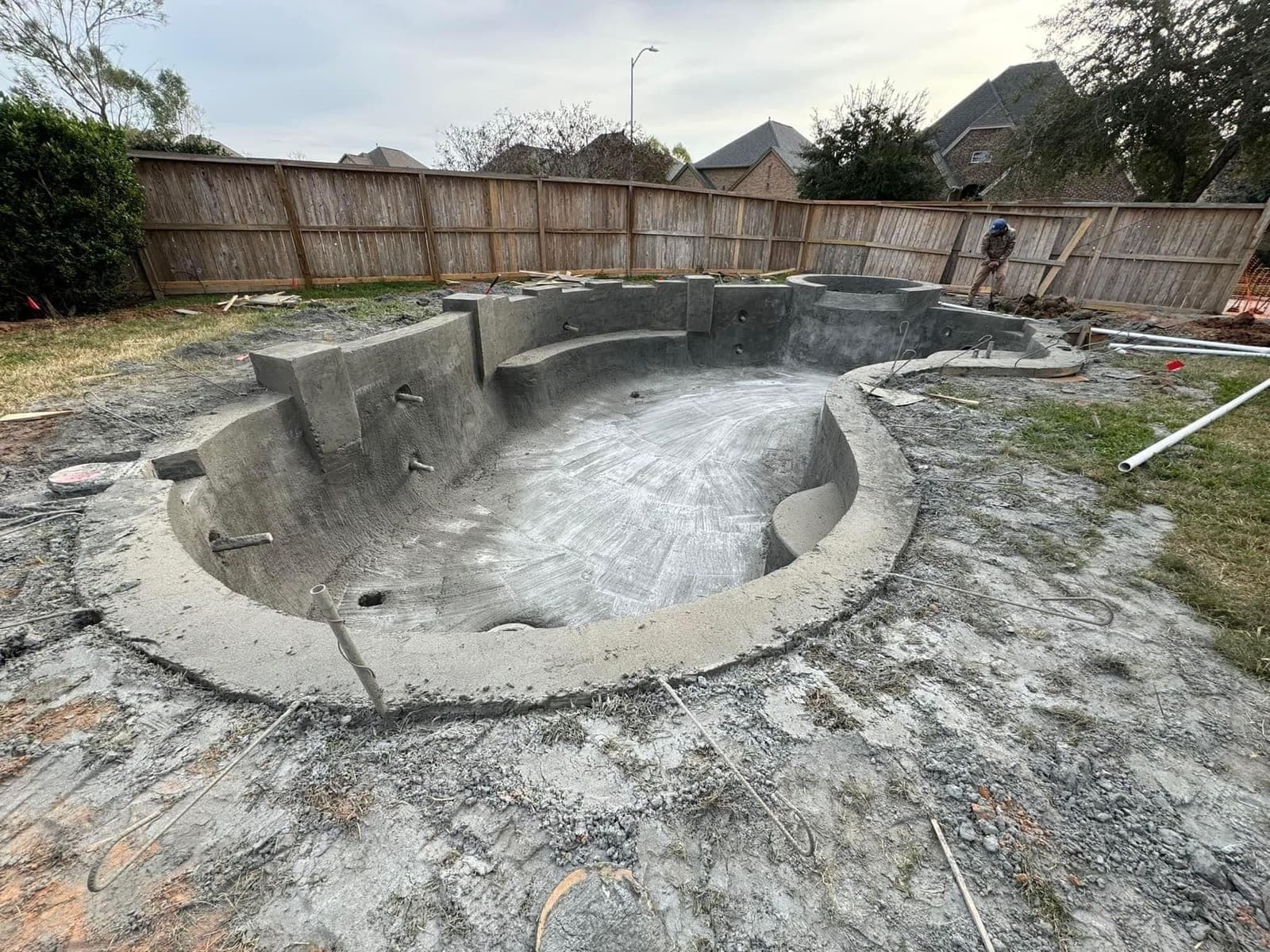
Ask what a gunite shell costs and you will get a version of the same answer everywhere: it depends. That is true, but it is not the whole story. Underneath most gunite quotes is one number, the cubic yards of material the shell needs, and unlike price, that number can be worked out from a plan. Understanding how it is derived tells you why two pools with the same surface footprint can be quoted very differently.
What follows is the standard method. The engineer's plan governs any real job, and the numbers below are typical ranges, not a specification for your pool.
Yardage is surface area times thickness
A pool shell is not a solid block of concrete. It is a shell: a layer of sprayed concrete following the floor and the walls. So the volume is the interior surface area of the pool multiplied by how thick that layer is.
Concrete is sold and measured in cubic yards, and a cubic yard is 27 cubic feet. So once you have the surface area in square feet and the thickness in feet, the arithmetic is: surface area times thickness, divided by 27.
Worked example
Take a simple rectangular pool, 32 feet by 16 feet, with an average depth of about 5 feet. The floor is 32 times 16, or 512 square feet. The walls are the perimeter, 96 feet, times the average depth of 5 feet, which is 480 square feet. Together that is roughly 992 square feet of shell surface.
At a 6-inch shell thickness, which is 0.5 feet, that is 992 times 0.5, or 496 cubic feet. Divided by 27, that is about 18.4 cubic yards before any allowance for rebound or extra material at the thicker sections. At 8 inches instead of 6, the same pool is about 24.5 cubic yards. Two inches of thickness moved the number by a third, which is why shell thickness is not a detail.
Then add rebound
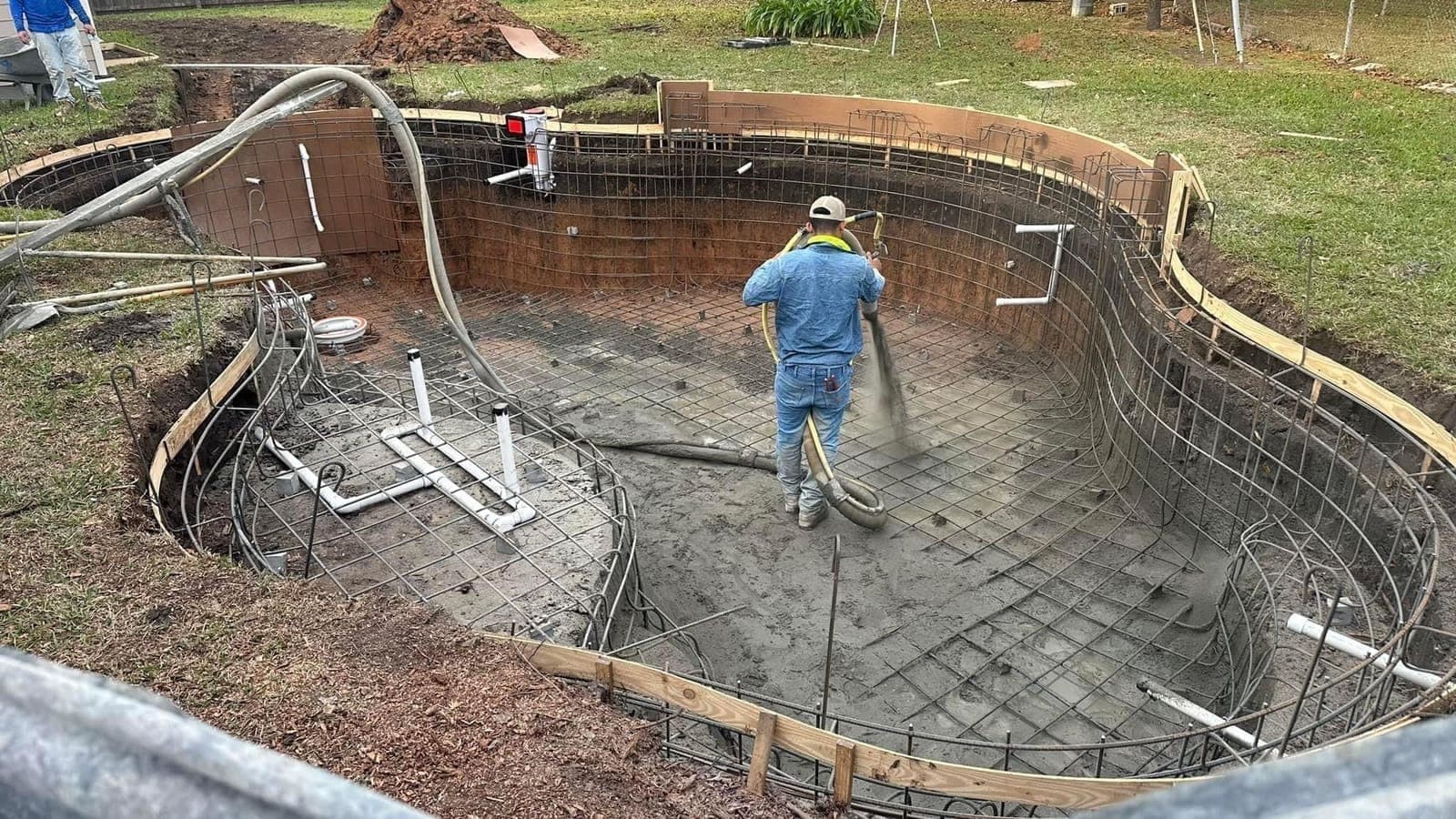
Rebound is the material that bounces off the surface during placement and does not stay in the shell. It is a real and unavoidable part of dry-mix gunite, and it has to be bought even though it never becomes part of the pool. Rebound runs higher on vertical walls than on the floor, because gravity is working against the material. Any usable estimate adds an allowance on top of the calculated volume rather than quoting the theoretical number.
What adds material beyond the basic shell
- Bond beam at the top of the wall, which is thicker than the wall below it
- Deep ends, where both the floor area and often the required thickness increase
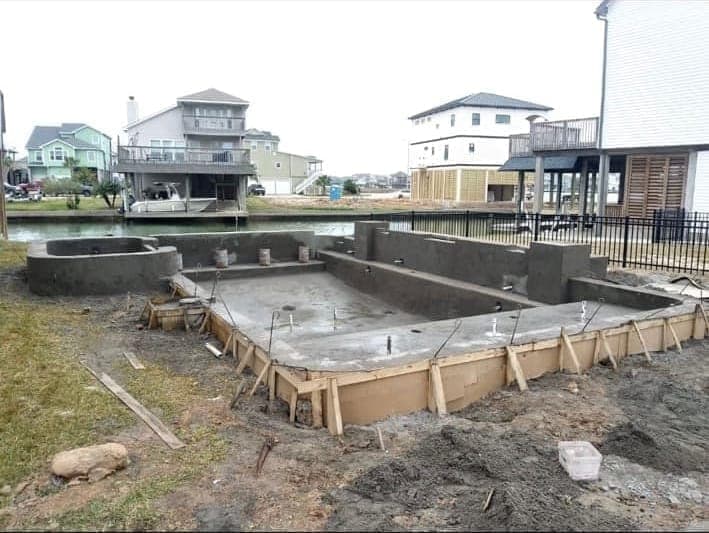
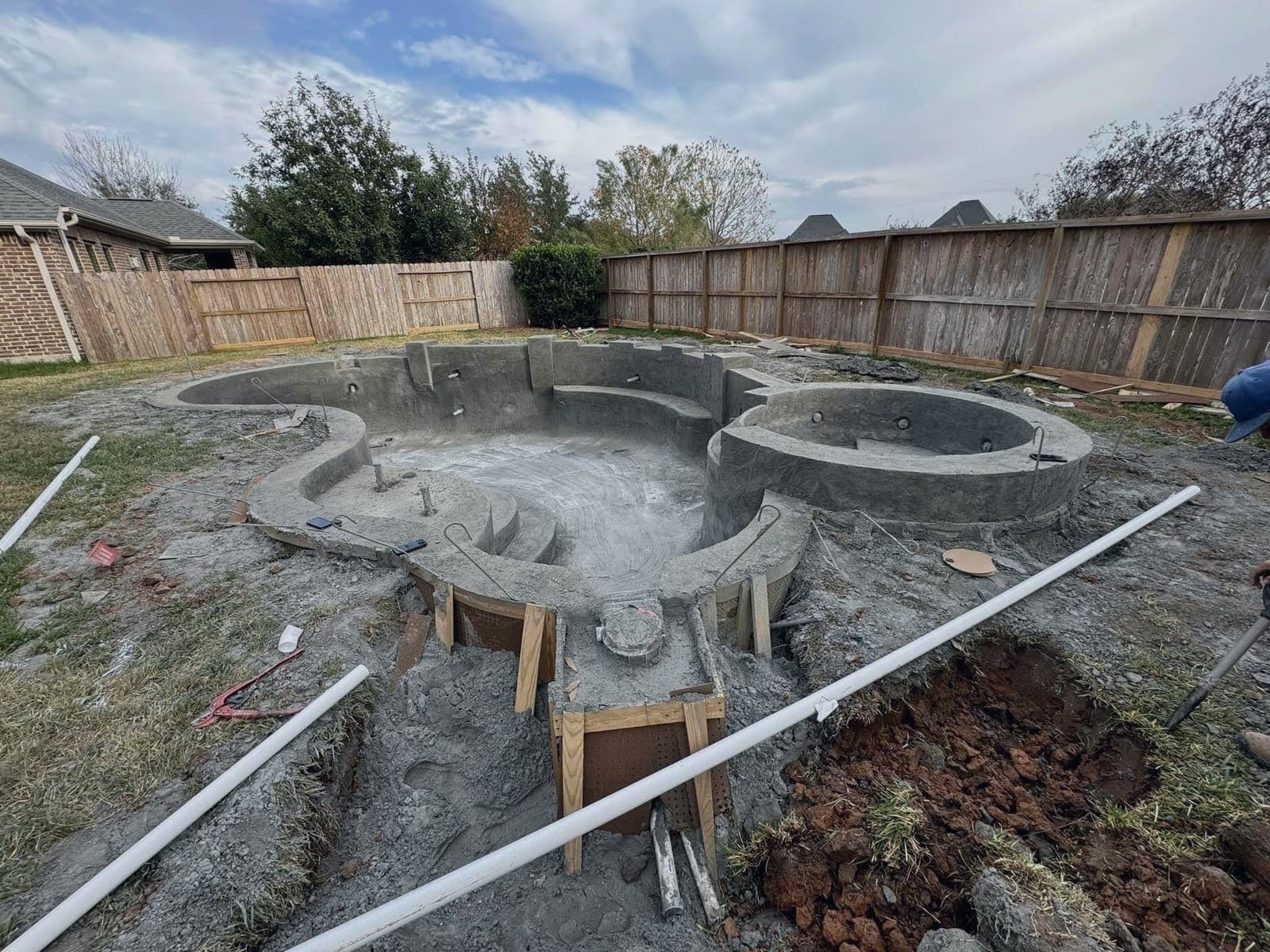
- Steps, benches, swim-outs and tanning ledges, each of which is solid formed concrete rather than a thin shell
- Raised walls, spa walls and any structure standing above the water line
- Attached spas, which are effectively a second small shell with their own walls and floor
- Rock features, grottos and waterfalls, which are shot and carved and can add substantial volume
- Retaining walls the pool design depends on, if they are in the same scope
This is why a freeform pool with a spa, a tanning ledge and a raised wall needs far more material than a plain rectangle covering the same square footage. The footprint is the same; the amount of formed concrete is not.
What yardage does not tell you
Yardage sets the material, and material is only part of a shell price. Access is the other half. A backyard where the rig parks at the kerb and the hose runs thirty feet is a different job from one where the hose runs two hundred feet around a house, or where a fence has to come down, or where the only route is a neighbour's driveway. Two pools with identical yardage can be genuinely different jobs to shoot.
Use it as a sanity check, not a quote
The useful thing about knowing the method is that it makes a quote legible. If you can work out roughly what a pool should need, you can ask a sensible question about a number that looks unusual in either direction, and a bid that is far below everyone else is often a bid that assumed a thinner shell or no rebound.
If you have plans or dimensions for a pool anywhere from Houston to Beaumont, send them over and we will work the shell out properly.
Frequently asked questions
How do you calculate how much gunite a pool needs?
Multiply the interior shell surface area, which is the floor area plus the perimeter times the average depth, by the shell thickness in feet, then divide by 27 to convert cubic feet to cubic yards. Add an allowance for rebound, plus extra material for the bond beam, steps, benches, raised walls and any spa or rock features.
How many cubic yards of gunite does an average pool take?
It depends on size, depth, shell thickness and features, so there is no single figure. As an illustration, a plain 32 by 16 foot pool with an average depth of about 5 feet and a 6-inch shell calculates to roughly 18 cubic yards before rebound and before any steps, benches, spa or raised walls are added. The same pool with an 8-inch shell is closer to 25.
How thick is a gunite pool shell?
Shell thickness is set by the engineer for the specific pool and soil conditions, and it is not uniform: the bond beam and deep-end sections are thicker than the general wall and floor. A change of a couple of inches in thickness changes the total material by a large margin, so it is one of the first things to confirm on a plan.
Why does rebound get included in a gunite estimate?
Rebound is the material that bounces off during placement and never becomes part of the shell. It still has to be purchased and moved, so it is accounted for on top of the calculated volume. It is higher on vertical walls than on the floor because gravity works against the material.
Why do two pools the same size need different amounts of gunite?
Because footprint is not volume. Steps, benches, swim-outs, tanning ledges, raised walls, bond beams, deep ends, attached spas and rock features are all formed concrete rather than a thin shell, and each adds material. A freeform pool with a spa and a ledge needs considerably more than a plain rectangle of the same square footage.
Planning a gunite pool on the Gulf Coast?
We have shot shells across Houston to Beaumont for over 20 years. Get a free, no-pressure estimate.