Gunite Guide
Concrete Cancer (ASR) in Texas Pools: What It Is and What to Ask Before Your Shell Is Shot
October 21, 2026 · 9 min read
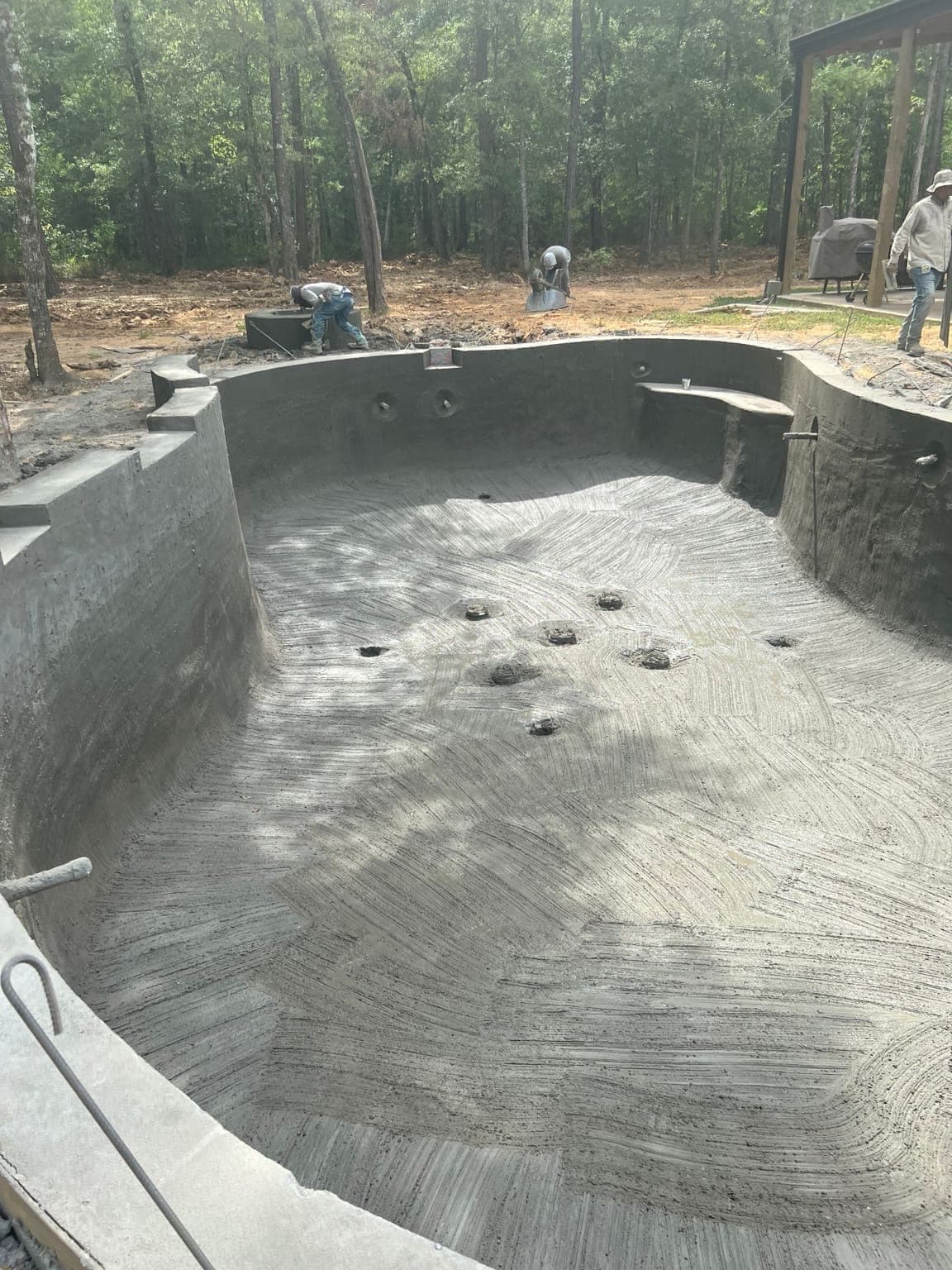
If you have read about pools around Austin cracking apart a few years after they were built, you have read about alkali-silica reaction, or ASR, which owners have taken to calling concrete cancer. Texas Monthly reported in October 2024 that it had hit more than 250 pools built across Central Texas since 2017, with many more likely, and that there is no permanent fix. If you are planning a pool in the Houston area, or you own one, it is a fair thing to ask about.
Here is what it is, what it does and does not mean for a pool here, and what to ask before a shell goes in.
What ASR actually is
Concrete is cement, water, and aggregate, meaning the sand and stone. Anol Mukhopadhyay, a senior research scientist at the Texas A&M Transportation Institute, described ASR to Texas Monthly as a chemical reaction between the alkalis in wet cement and reactive silica minerals in that aggregate. The reaction makes a gel that soaks up water and swells. In a structure that holds water every day of its life, the gel keeps swelling, and the concrete cracks from the inside in a spreading spiderweb pattern. Water gets into the cracks and eventually reaches the steel.
The important part is that ASR is decided by what went into the concrete. It is not caused by the soil around the pool, the weather, or how the water is balanced. Those things can make a damaged shell worse, but the reaction itself was set up the day the concrete was mixed.
Why Central Texas got hit
According to the same reporting, most aggregate mined for concrete in Texas reacts with cement to some degree. A mix with even mildly reactive rock needs a supplementary cementitious material, most often fly ash, to replace part of the cement and shut the reaction down. Fly ash is a byproduct of coal power, and as coal plants closed in the mid-2010s, good fly ash got more expensive and harder to find. Some suppliers left it out.
In one lawsuit Texas Monthly described, core samples showed ASR in at least eight of nine pools from a single builder. The suit alleges the shotcrete came from one Austin supplier, whose owner confirmed he had not been putting fly ash in the mix, and that supplier's sand and gravel came from quarries along the Colorado River. In March 2023 the Texas Supreme Court consolidated the lawsuits against that concrete company into a multidistrict case that has grown past one hundred cases.
Does it happen in Houston?
The documented cluster is Central Texas, around Austin and its suburbs. We have not seen reporting of a comparable wave in the Houston area, and we are not going to pretend there is one. But the honest answer is that no region gets a pass. ASR depends on the aggregate and the mix, not on a city, and if most Texas aggregate is at least mildly reactive, then the protection is the same everywhere: the right mix, from a supplier who knows what is in it.
Houston adds one thing worth knowing. Mukhopadhyay also explained that ASR can creep along slowly for years until cracks from structural problems let more water in and speed it up. On expansive clay and high groundwater, a shell that is under-reinforced or poorly cured is more likely to crack for structural reasons, and those cracks give any reaction in the concrete a head start. Good steel and a proper cure are part of the defense, not a separate topic.
Is gunite safer than shotcrete?
We shoot gunite, and we would like to tell you it is immune. It is not. The headline cases were shotcrete, the wet mix delivered by ready-mix truck, but dry-mix gunite is also cement and sand, and siliceous sand can be reactive too. The reaction happens between the cement and the aggregate, whichever way they were placed. The method does not protect a shell. The materials do.
What prevents it
- A supplementary cementitious material in the mix, usually fly ash or slag cement, replacing part of the portland cement. This is the main defense, and the Texas Department of Transportation requires it on concrete for public infrastructure.
- Aggregate that has been tested for reactivity. The standard laboratory tests are ASTM C1260 and ASTM C1293, and ASTM C1778 is the industry guide to reducing ASR risk.
- A supplier who tests on a schedule. One Austin supplier implicated in the lawsuits told Texas Monthly it now tests its mix twice a year.
- Sound structure: correct steel, no cold joints, and a proper water cure, so the shell does not crack for other reasons and invite water in.
Residential pools in Texas have no equivalent of the TxDOT rule in practice. Texas does not license pool builders, and Texas Monthly noted that some unincorporated counties do not require a permit for a pool at all. The check has to come from the owner, the builder, or the shell contractor asking.
Four questions to ask before your shell is shot
- What is in the mix? Ask for the mix design or the batch ticket, and whether fly ash or slag cement replaces part of the cement.
- Where does the sand and aggregate come from, and has it been tested for ASR reactivity? When was the last test?
- Who supplies the material, and how long has the contractor used that supplier?
- What is the steel schedule, and who keeps the shell wet after the shoot?
Ask any shell contractor these, us included, and expect a straight answer. Builders often never think to ask. In Texas Monthly's reporting, one Central Texas builder with years of training said he had never checked whether his concrete providers tested their mixes, because he would not have known to ask.
If you already have a pool
Most cracks are not ASR. The common one is crazing, a fine web of shallow lines in the plaster that is cosmetic and stable, and our crack guide covers how to tell plaster from structure. ASR is different in that it does not stay put. It keeps spreading and widening, it goes into the concrete rather than sitting on the surface, and the pool eventually loses water.
The only way to confirm it is a core sample from the shell and a petrographic examination, where a lab studies thin slices of the concrete under a microscope. It is not cheap. One owner in the Texas Monthly story paid about $11,000 for coring. If you suspect it, do not drain the pool to look, for the same groundwater reasons the crack guide explains, and be wary of paid treatments sold as a cure. Experts quoted in that reporting said the epoxy-type fixes on the market at best slow the reaction, and that the only permanent answer for a confirmed case is removing the shell and rebuilding.
If a pool built in the last several years is showing a spreading web of cracks, get someone qualified to look at it before you spend money on cosmetic repairs.
Frequently asked questions
What is concrete cancer in a pool?
It is the popular name for alkali-silica reaction (ASR), a chemical reaction between alkalis in cement and reactive silica in the sand and stone of the concrete. It forms a gel that absorbs water and swells, cracking the shell from the inside. It has damaged hundreds of pools built in Central Texas since 2017.
Are Houston pools affected by concrete cancer?
The documented cluster of cases is in Central Texas, around Austin. ASR depends on the aggregate and the concrete mix rather than the location, and most Texas aggregate is at least mildly reactive, so the protection is the same in Houston: a mix that includes fly ash or slag cement and aggregate that has been tested.
Can concrete cancer in a pool be fixed?
Not permanently. The reaction is irreversible. Repairs and epoxy treatments may slow it, but experts quoted in Texas reporting say the only permanent answer for a confirmed case is removing the shell and rebuilding.
How do I know if my pool has ASR?
ASR shows as a spiderweb or map pattern of cracks that keeps spreading and widening, eventually with water loss. Ordinary plaster crazing looks similar at first but stays shallow and stable. The only way to confirm ASR is a core sample of the shell and a petrographic examination by a lab.
Does gunite get ASR, or only shotcrete?
Either can. The well-known Texas cases were shotcrete, but gunite is also made of cement and sand, and the reaction happens between those materials however they are placed. What protects a shell is the mix: fly ash or slag cement and tested aggregate.
Planning a gunite pool on the Gulf Coast?
We have shot shells across Houston to Beaumont for over 20 years. Get a free, no-pressure estimate.